A New Day is Dawning because of Bitcoin, Ethereum, Crypto Assets and the Blockchain
The majority of my research and analysis of late has been very focused on the Crypto-Asset sector. Equities hold little interest for me at the current valuations, which entirely reflect inflation due to Central Bank actions in regard to interest rates and money printing.
Within the Radar Fund tab above, I will post numerous charts to help explain the strength and growth in the Crypto sector. This growth has resulted in the Radar Fund posting a 184% gain YTD.
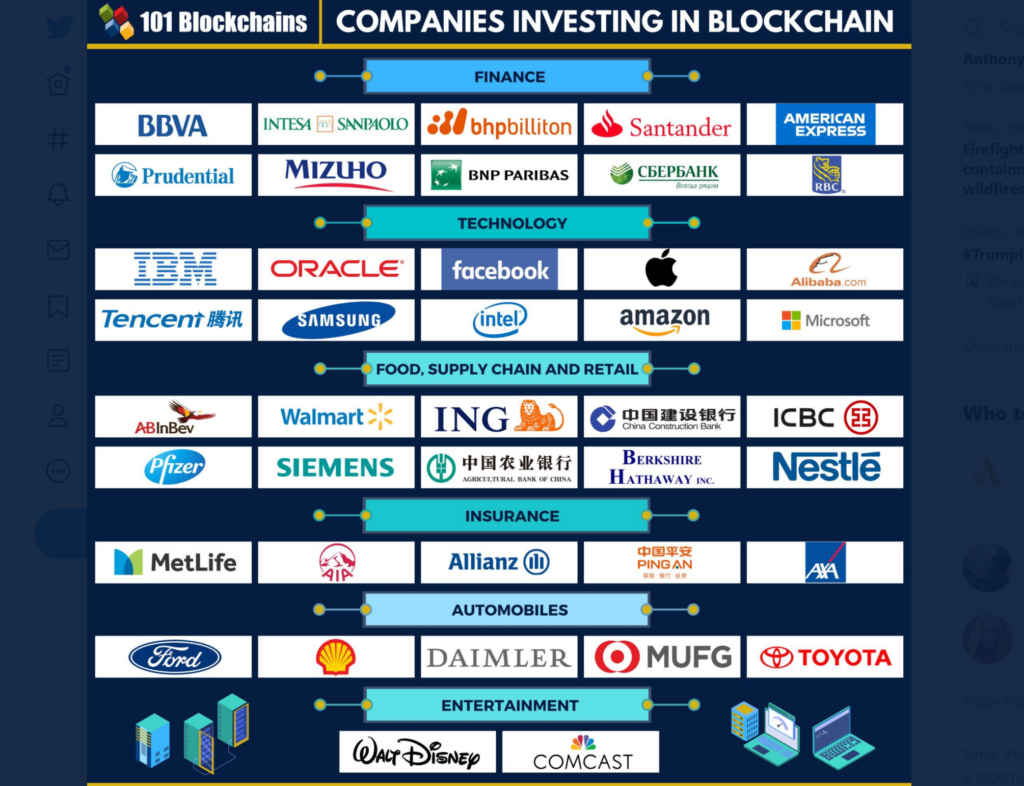
I am discussing Crypto here on the main page of my website because of the importance of the 2020 developments that extend well beyond the two main Blockchains of Bitcoin and Ethereum. Both BTC and ETH have had great years so far in regard to price growth, demand and broader participation. While this is very good news, the real story of the year is the expansion of business platforms using Blockchain technology to expand commerce and efficiency in many industries. This growth is demonstrated by the following:
1) The Radar Fund holds financial interests in 101 companies/platforms beyond BTC, ETH and LTC. The investment cost of these 101 holdings is a function of the current value of BTC and ETH, the two currencies used to purchase the financial interests in them. As the price of BTC and ETH rise, the cost of acquisition for the other tokens also rises as the current price of BTC and ETH are used to measure the purchase cost rather than the historical prices in effect at the time the other tokens were purchased. This daily real-time mark-to-market of acquisition cost when compared to the current market values of the 101 tokens purchased provides insight as to which platforms are growing faster or slower than the two main Crypto Blockchains of BTC and ETH. By performing this exercise daily and tracking results over time, I believe I am better at identifying the most valuable and accelerating growth businesses in the Crypto sector. The comparison additionally gives me a barometer of overall industry growth. If the basket of 101 tokens that form the Radar Fund industry component are generating price expansion faster than BTC and ETH it demonstrates investment money is flowing into industry faster than it is flowing into Crypto-currencies for holding purposes. To date, as of August 9, 2020, the industry component of the Radar Fund has grown above and beyond BTC and ETH by 39.22%. This industry growth is a key component of the overall YTD return of the Radar Fund’s exceptional 184% growth.
2) The significant and consistent expansion in the number of Bitcoin and Ether Wallets/Addresses further demonstrates the increased penetration and adoption of crypto. YTD, Bitcoin wallets have increased by 17%, and are projected to end the year with a total increase of 27%. YTD, ETH wallets have increased by 46%, and are projected to end the year with a total increase of 62%.
3) Institutional participation in the Crypto sector is expanding as measured by the growth in the use of Futures to hedge and meet obligations in crypto denominated transactions. Futures contracts Open Interest for BTC has reached approximately $5 billion, while Open Interest contracts for ETH approximate $1.5 billion. These are all-time highs in Futures activity Open Interest and demonstrates the growing acceptance and use of Crypto-currencies in the deal making and trading markets.
The array of businesses and industries that are represented by the Radar Fund holdings range from banking, insurance, hedging, travel and leisure, art, market place trading, identity and fraud protection, exchanges, media & entertainment, supply chain management and provenance, education, health, and each day the list expands. It is clear that the use of Blockchains as a technology platform for reducing costs and empowering parties to transact through direct peer-to-peer connections that execute based on established contracts that do not require middle-men to approve, oversee or control the contractual compliance is a better way of doing business in our digital world.
A new day is dawning.
July 2020 TJ Connolly’s thoughts on Bitcoin, Crypto, Blockchain, Banking, and a New Industry
July 27, 2020 This Link is to a discussion document I wrote for those new to or thinking about this industry sector
https://sway.office.com/FryuAW9w1zBbTTcC
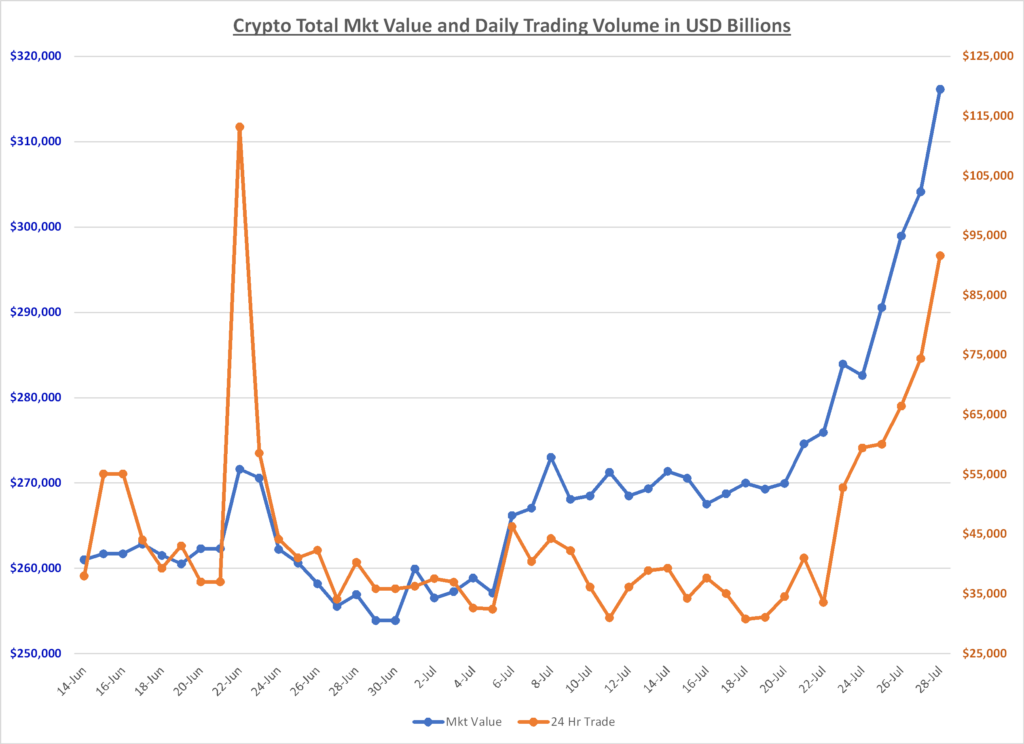
The recent move of investment capital into the Crypto sector is evidenced by the growth in Market Capitalization and Daily Trading Volume
Bitcoin, Ethereum, and Crypto Assets in the Current Environment
July 7, 2020 UPDATE
The groundwork has been being laid for a significant move in prices. Over the past 24 hours the direction of that move in prices is becoming very clear to me. We are in my judgement going much higher in prices. I have been aggressively buying over the past 48 hours, with a particular concentration over the past 24 hours. My holdings YTD in Crypto are up 117% since December 31, 2019. The price movement is across the board, with DeFi and CeFi leading the charge. The currencies should follow suit. I am particularly focused in the currency sector on Ethereum. I expect a large price change here, greater than what I expect for Bitcoin.
From JULY 6, 2020
I typically focus on Crypto under the Radar Fund menu tab. Today, I believe it important enough to write a bit on Bitcoin, Ether, and other token assets that represent the DeFi sector of the Blockchain and Crypto Industry on the Main Page of this website.
Bitcoin and Ether have been treading water lately. Price moves have been relatively confined to a range that results in the lowest level of 10-Day price volatility that I have seen since 2017. Additionally, the daily unit volume of Bitcoin and Ether traded on exchanges is very low, approaching the lowest daily levels since 2017.
We are very close to a breakout in prices. The key indicators, impacted by the action on July 6, 2020, are strongly indicating higher prices. This could be a consistent and progressive move higher across the spectrum of Crypto Assets.
The overall market cap of the Crypto universe is presently $256 Billion. The daily trading activity is in the $30-$38 billion area.
In this relatively calm seemingly uneventful market sector there is significant movement in a sub-sector that is striking. It is the DeFi sector, or Decentralized Finance. This industry sector is developing rapidly, and recently investors have taken notice. Price appreciation in companies focused on this area is rewarding investors with meaningful returns. For example, consider the following:
1) The company Celsius is a new world banking enterprise. The company in a simple form accepts deposits of Crypto assets, such as Bitcoin and Ether (accepts many other crypto assets as well). Based on market demand for borrowing these crypto assets, an interest rate for loans is determined. Celsius pays its depositors 80% of the interest earned on lending activities. The interest rates being earned by these depositors is greater than 10 times the rates being earned in US $ deposits at traditional lending institutions. This business model has resulted in Celsius paying out the equivalent of $24+ million in interest to its depositors, lending activity of $6 billion, with $630 million in deposits. The value of the Celsius token was available for purchase at 3.5 US cents a couple of years back. Today it is prices at $.40+ cents. Since March, 2020, it has increased in value from 6.5 cents to its current value. Presently, Celsius is doing a Private Placement of a portion of its equity and has $15.7 million committed. https://app.bnktothefuture.com/pitches/celsius-network
2) Compound recently issued its token at approx. $50 per token. Compound represents a similar platform to Celsius, enabling the lending or borrowing of crypto assets. Supplying tokens as a depositor earns market rate interest as determined by the lending rate to borrowers. Somewhat different than Celsius, the payout by Compound is not set at 80% of the borrowing rate and may therefore exhibit different rates of return than Celsius. The Compound token zoomed 7X upon its issuance moving from $50 to $350. Presently the Compound token is priced at $203.
3) Kyber Network is one of the earliest Token Swap platforms. This enterprise and its CEO have been a favorite of mine since the company’s inception. Unlike a Centralized Exchange the KNC platform does not hold your assets. You connect your wallet to Kyber, designate the token you wish to use for an exchange from your wallet and the token you wish to receive from the KNC Swap technology and that is broadcast over the blockchain and filled. KNC assembles the bid and ask prices across multiple exchanges to deliver a fair market value to you in the exchange process. The speed and security of this platform make this one of my favorite platforms for building The Radar Fund portfolio.
4) Synthetix
5) Switcheo
Randomness coupled with hit and run moves
June 27, 2020
The current environment across so many sectors reflects uncertainty and quick moves in and out of asset classes. Investors are chasing returns, some succeeding and others getting caught in the back wash. This is a dangerous market.
I have done well by being patient and very selective in the equity market, avoiding the chase and turbulence, waiting for better market set-ups. In the crypto market there are very new and significant moves under the flatness of the leaders Bitcoin and Ether.
This past week saw more weakness than strength in equities. The parabolic curve of the Covid-Virus infections spreading across the U.S. is unsettling the economic promise of getting back to normal. The sugar high of FED intervention is waning it would appear, and the instability of U.S. leadership is leaving us rudderless. The 700 point DJIA decline on Friday has created a weekend of uncertainty, and with no positive news on Saturday or Sunday, the market could be in for a very bad Monday. The over-valuation of equities on an historic basis coupled with the randomness of leadership in a crisis environment leaves us set-up for more quick turns and mis-directions. I will remain steadfast in my view that “hiding” in Gold miners and equity dedicated cash is the best position to be in. I do have a small short position on the S&P 500 as I look to Sunday night’s/Monday’s opening.
Crypto is very unsettled as well. Strong abnormal price movements are taking place in the DeFi sector, along with rates on various tokens at extremely high levels given short-term demand for buying tokens on margin. Rates as high as 23% are being offered, and price moves of 2X and 3X are happening in this sector. As I write this, there is a general pullback occurring with some of the more volatile increases being sold to lock-in gains. This is occurring while we have price weakness in Bitcoin and Ether, both trading near recent lows of $9,000 for BTC and $225 for Ether. Something strange is going on, and I am hard pressed to put my finger on it.
I will write more over the weekend under the 187 Portfolio and the Radar Fund tabs, trying to explain my actions in this unusual environment. Presently, my returns on equity Y-T-D approximates 20%. My Y-T-D return on Crypto approximates 93%. Very strong results, but in this environment they could be gone in a flash. I have been here before and I know how quickly things may change. Be careful out there!
I have returned! Been away, moving furniture and stuff from vacation home for upcoming renovation.
Amazing what you accumulate over 32 years. My wife and I as newlyweds bought a home in Vermont to give us an alternative lifestyle out of Manhattan back in 1988. Children came, and we spent many days in Vermont raising out children to ski, to enjoy the mountains, to have a concentrated time with Mom, Dad, and each other, and to build friendships that complimented their New York experience. Now after 32 years, it is time to renovate. It is amazing how much stuff you accumulate in one location over that time. Memories and junk. Love the memories, but clearing out the house took forever. In any event, the sledge hammers have the house now. Can’t wait for November when it will be finished.
Good to be back and writing with you again.
Be safe and healthy,
Best,
Tom
Post-Stay at Home Behavior may have a Dramatic Impact on Investing
What is the saving rate your money earns at your bank?
What would you imagine are the lasting effects of an abrupt end to what you accepted as normalcy? Each day we arise and begin our day, very similar to the prior day. We begin our routine, our cup of coffee, a fast review of the news, checking in on those still sleeping, and getting ready for work. Future actions enter our mind, bills to be paid, matters awaiting us at our job, relationship joys and challenges, salary raise hopes, car servicing, food needs of the house, that lunch planned for today, the meeting(s) to be had, and so much more. Our mind fills with the hundred other things that our day will encounter. And so, another day has begun.
But today none of the above feels normal. There is no work today. There is no need to hold to a schedule. There is no paycheck. The bank account is shrinking or may already be empty. There are worries about health, about paying the bills, about access to food, about our children’s educational needs, and even about going out for a walk.
A week goes by, and then two, and then a month goes by. Uncertainty is the operative word in a world that denies us what we knew and believed to be normal. Our future is clouded and our worries build.
The word pandemic becomes the topic of the day, a word we rarely heard prior to the year 2020. Headlines, big and bold, carry words of Depression era unemployment, of a daily death count, of a daily infection rate, of the lack of basic supplies and equipment to protect the health of all, and attacks on government leaders for perceived failures to protect society.
There will be fallout from this change in life. A shock to the system that we took for granted shakes the grounding of our beliefs and expectations. There must be consequences, outcomes, new choices, that are driven by our inability to clearly see the future. The impacts of the Covid-19 virus will make us hesitate, make us rethink what is important.
How much money do we really need for that rainy day? More or less than we previously kept in reserve? Will we ever take a vacation again? And to where? On a cruise ship? On an airplane? How much money should we allocate to vacations vs building that reserve fund? Enough to cover necessities like food, toilet paper, antiseptics, medicines? And what about the elderly, the most vulnerable, that need the younger generations to provide care and safety?
The lessons we are learning will change behavior. It is unlikely that we will live and interact in the same manner we did prior to this pandemic. Yes, I believe there may be that initial feeling of high emotion, to believe we are beating this thing and that our lives may quickly return to what we knew, but that impulse will fade as jobs fail to come back, as unemployment remains high due to reconfiguration of the normal work day, as companies adopt more technology to make them less reliant on people to make, distribute, and sell their products. Healthcare will change, education will change, transportation will change, supply chains will change, global trade will change, and politics will get even more difficult as the matters that divide us are blared by politicians in search of votes to keep their roles in place.
I foresee a world where we save more, spend less, reassess our values, focus on security versus adventure, as we move away from embracing the experiences of life as a priority to one where we focus on safety and a return of predictability.
If I am right about saving more, then the everyday person will become much more aware of interest rate differentials.
Savings grow based on the interest rate that depositors are paid for keeping their money with a bank or financial institution. In a world with money only earning 0.25% interest per year, which on a $1,000 deposit earns the saver only $2.50 per year, the saver has no incentive to keep their money with a bank. Yet, the focus on saving, on being prepared for rainy days, demands a safe place to keep our money. Will people accept such low returns on their savings even though the bank is lending out the depositor’s cash at rates from 3% to 25%? The bank is keeping all of the profits, and in fact in some instances is even charging service fees that exceed the interest being earned. I think we will see a much more active and discerning saver. Comparison shopping for higher interest rates will become important to all depositors, and there are significantly higher alternatives in the market.
It will be the alternative financial institutions that will attract more capital as depositors select these newly formed enterprises for their saving needs. If that is the case, then investing in those new enterprises, enterprises that will provide better saving rates and greater incentives to save, will be the wise choice.
The Quiet is not without Meaning
April 28, 2020 the Bitcoin action is so very slow and steady.
No volume breakouts. No big price moves since the break on March 12, 2020 when Margin selling across all asset classes ruled the markets and Bitcoin closed at $4,857. Since then it has been a steady climb back, washing out the panic selling from that March date. Interesting to me is that on March 23rd, when the equity markets formed a tentative bottom, Bitcoin gave a BUY signal when it closed that day at $6,491. Today, the price is $7,747 as I write this.
Keep in mind the date, as we are close to the month-end of April, and Hedge Funds will look to manage their books to post a good month after the pain of March. There is no desire for volatility, as a sense of calm is sought. Yet, the price of Bitcoin looks to me to be like a spring waiting to be released. It has cleansed itself of the March lows, climbing back up to the underside of the lower trendline that was guiding the price before the panic selling due to the CoronaVirus and the Oil shock. If it breaks above this trendline, it has plenty of room to run. $9,400 appears to be a good target.

With the Halvening occurring in May, new supply and demand dynamics will come into the picture. How long will it take for this to be digested and revealed in a new price structure remains to be seen, but the groundwork appears to be set-up for an attractive performance. We shall see……….
The Fallout
April 22, 2020 .
The equity market, the gold market and the crypto market are in rally mode
Failed bounces off of lows should be in the front of every investor’s mind. I am watching closely. Off of the March 23rd low, we hit a high on April 17, 2020 in the 187 Portfolio. Comparing today’s and each day’s prices for each stock in the 187 Portfolio to the April 17th prices may give a sign of a failing rally or real animal spirits supporting a V shaped recovery. Right now, there are only a handful of stocks with prices at or above the April 17th prices. This has my attention.
For the day
Gold is up $48 per ounce or 2.8%. Stocks of the Gold Miners are higher, with Newmont Mining (NEM) hitting an all-time high.
BTC is trading in the $7,100 area and needs to break resistance that I see at $7,400. If it clears that with some distance, say by $100 to $200, then $9,500 is the next point to get over.
Equities are showing strength, but I still do not trust this rally which is happening off of the latest stimulus from governments around the world. The 187 Portfolio is up 2.2%, while the DJIA and the S&P 500 are up 1.97% and 2.33%, respectively.
The Semi-Conductor stocks are rockin and rollin today. The heavy debt laden companies are the laggards.
- April 21, 2020
Watch out for the Margin Clerk today, as things get sold that holders do not want to sell.
Best performer today from the 187 Portfolio is FLIR, up 12.1%. Amazon is using thermal cameras in their warehouses.
Worst performer today from the 187 Portfolio is NBR, down 14.8%
The equity market may reset lower, and the question is how far? Typically there is an overshoot to the downside and the upside when capitulation occurs. How might the decline be measured and forecasted? Consider this:
Since 2007, for every dollar of levered cash flow generated by the 187 Portfolio, price growth has risen by 1.25X the growth in cash flow. Total Cash flow forecast for 2020 pre-Virus was $1,054.20 per share for the entire 187 Portfolio. If we reduce this by 20% to reflect the economic freeze impact on the year 2020, then we arrive at $843.62 per share. At a multiple of 22.59X, the price to cash flow multiple as of this morning, then the loss of $5,946.26 in projected share price would result in a projected decline of 25% in the market from today’s prices.
If we instead model based on 2021 projected cash flow of $1,072.85, pre-adjustment for the virus impact. Then the rate of growth in cash flow from the adjusted 2020 amount ($843.62) to the existing 2021 amount ($1,072.85), would be 27% Y-o-Y. As a point of reference, the compound annual growth rate in cash flow averaged over the past 12 years is 8.3%. The needed growth of 27% in 2021 over 2020 remains a challenge, and I anticipate a further equity price decline as the visibility to 2020 and revised projections of 2021 come to light at levels that may very well be less than what would be needed to support today’s equity prices.
Oil, what ideas going forward seem to make sense
April 20, 2020
This is a date that will be recalled for years to come. It is the day a barrel of oil on the Futures exchange for May delivery went negative. Last check, an oil producer would have to pay you $37 per barrel for you to take delivery.
I am going to write at the moment in a sense of free association and will ultimately edit this down to something more well thought out.
Like the coronavirus, this is an event never imagined or experienced. There is so much oil being produced that there is no storage facilities left to take the oil. Physical supply is greater than physical demand on the Spot market. The rate of supply will continue to exceed demand for the near-term and looking out to May, the market makers see no growing demand, no meaningful reduction in production, and a net current supply plus future production that has no place to go.
I remember being in the audience in the year 1985 when Leon Hess, the founder of Hess Oil, ranted about the Futures market as a weapon of destruction and irrationality. His point was that each day more oil traded on the Futures Exchanges than existed in the ground, and to him that made no economic sense and merely represented gambling. Well it took a long time, but maybe he is about to be proven correct.
Supply and demand should not result in negative prices. Suppliers produce to meet demand at a given price. Buyers take oil at a given price to refine into by-products such as gasoline and jet fuel that are priced based on usage demand. Suppliers have been taught that they may hedge the oil in the ground by selling it on the Futures market for future delivery. That makes sense, except that the futures market also allows non-producers and non-users of oil to “bet” on the changes in the price of oil by buying and selling futures contracts for profit. This creates an artificial component of pricing, and in a crisis when contracts need to be unwound, the holders of long futures contracts must get out at any price as the price falls, and this accelerates the price decline as more sales occur with no offsetting buyer demand. In a market where there are no physical buyers due to excess supply in the physical market, this becomes a perversion of price as the laws of supply and demand no longer apply.
Okay, so this represents to my mind the current state of affairs in the oil market. How do I make money from this price perversion?
Stock prices in Oil companies have fallen quite a bit, and to buy these stocks, those with solid balance sheets, must be a long-term play. Smaller companies will be bought by the larger companies as these smaller enterprises desperately try to survive in a world where the market price is less than the cost to get the oil out of the ground. Identifying acquisition targets may pay off well, but the risk of bankruptcy of these same companies which will return a price of zero is a real risk.
What else? Gold keeps gnawing at me. Similar to oil it is in the ground and must be extracted to be able to trade on the market. Its demand in the market is driven largely by Central Banks who purchase gold as a store of value to offset the declines in purchasing power of fiat currencies. It is also used for jewelry and other purposes, but its main driver is by those who want to own it as a hedge against inflation and instability. It is not as prone as oil to oversupply concerns in the physical market given the limited production of this precious metal in any given year. The Futures market for gold exists but it is not as large or as liquid as the oil market, so it is less prone to attract large gamblers on its change in value. In this turbulent time, and with oil, one of the key economic variables in the world, employing hundreds of thousands of workers and impacting the cost of so many things that it is a component of, will demand for Gold rise as a safe haven asset to offset the loss of value from other assets that lack buyers in a new world order driven by health concerns?
My instincts say yes. The level of uncertainty in the world and the economic declines we are experiencing are likely to cause more and more institutions, central banks, and investors toward buying the safe haven asset that Gold represents. In a world where the Futures market is not in the position to provide current price protection for sellers of near-term future oil production, the price is unstable and the “gamblers” on oil prices may shift their focus to the more stable asset, Gold. If that is the case, then the traditional buyers of Gold will be joined by the “gamblers” who want less risk in this unstable environment, and the resulting additional demand may very well produce a continued rise in the price of the yellow metal. With this thought, buying shares in Gold Miners may be the best path to take.